Lietuvos chirurgija ISSN 1392–0995 eISSN 1648–9942
2026, vol. 25(3), pp. 280–286 DOI: https://doi.org/10.15388/LietChirur.2026.25(3).6
Appendiceal Diverticulum as a Modifier of Inflammatory Trajectory in Acute Appendicitis: A Paired Case Contrast Supporting the Hybrid Model
Radomir Gelevski
General Hospital Kumanovo, Department of Surgery, Kumanovo, North Macedonia
E-mail: radomirgelevski@hotmail.com
Gjorgji Jota
Ss. Cyril and Methodius University, University Clinic for Digestive Surgery, Skopje, North Macedonia
E-mail: jotamak@hotmail.com
Blagica Krsteska
Ss. Cyril and Methodius University, Medical Faculty, Institute for Pathology, Skopje, North Macedonia
E-mail: blagicadr@yahoo.com
Vladimir Andreevski
Ss. Cyril and Methodius University, University Clinic for Gastroenterohepatology, Skopje, North Macedonia
E-mail: vladimir.andreevski@medf.ukim.edu.mk
Abstract. Background. Acute appendicitis is increasingly recognized as a heterogeneous disease in which severity is not solely determined by symptom duration or inflammatory burden. The hybrid model integrates time-dependent progression with divergent inflammatory pathways influenced by anatomic and host factors. The role of appendiceal diverticular disease within this framework remains incompletely defined. Case presentation. We report a hypothesis-generating paired case contrast of two female patients with histologically confirmed appendiceal diverticular disease and divergent inflammatory trajectories. One patient developed localized phlegmonous appendicitis with normal serum bilirubin levels despite prolonged symptoms. The second patient exhibited rapid progression to gangrenous diverticulitis with fibrinopurulent peritonitis within 12 hours, accompanied by early bilirubin elevation, marked neutrophil predominance, and elevated procalcitonin. Both cases lacked hepatic or hematologic confounders. Discussion. Despite similar anatomic substrates, the clinical courses differed markedly, challenging a purely time-dependent continuum model. The dissociation between C-reactive protein and bilirubin behavior suggests that bilirubin reflects systemic inflammatory response rather than localized inflammation or symptom duration alone. Conclusion. This paired case contrast supports the hybrid model of acute appendicitis and suggests that appendiceal diverticulum may function as a conditional modifier of inflammatory trajectory. Serum bilirubin appears to reflect systemic response patterns rather than local pathology.
Keywords: acute appendicitis, appendiceal diverticulum, diverticulitis of appendix, hyperbilirubinemia, hybrid model, inflammatory trajectory.
Received: 2026-02-12. Accepted: 2026-03-15.
Copyright © 2026 Radomir Gelevski, Gjorgji Jota, Blagica Krsteska, Vladimir Andreevski. Published by Vilnius University Press. This is an Open Access article distributed under the terms of the Creative Commons Attribution Licence, which permits unrestricted use, distribution, and reproduction in any medium, provided the original author and source are credited.
Introduction
Acute appendicitis remains one of the most common surgical emergencies worldwide, yet its underlying pathophysiology is increasingly recognized as heterogeneous. Traditionally, appendicitis has been conceptualized as a single disease entity progressing along a temporal continuum from uncomplicated inflammation to gangrene or perforation [1, 2]. While this model accounts for many clinical presentations, it does not fully explain the frequent discordance between symptom duration, local tissue pathology, and systemic inflammatory response observed in clinical practice.
To address these limitations, alternative conceptual frameworks have emerged. The dual-entity model proposes that uncomplicated and complicated appendicitis represent biologically distinct processes [3, 4], whereas the hybrid model integrates elements of both progression and divergence. Within the hybrid model, appendicitis may evolve either through gradual inflammatory escalation or through distinct pathways characterized by rapid tissue necrosis and early systemic involvement, driven by interactions among local anatomic factors, microbial characteristics, and host immune response [5, 6]. This framework has gained increasing attention as a means of reconciling heterogeneous clinical and pathological observations.
Appendiceal diverticular disease represents a potentially important but underexplored anatomic substrate within this context. Although uncommon, appendiceal diverticula have been consistently associated with higher rates of gangrene, perforation, and periappendiceal inflammation when complicated by diverticulitis [7–9]. However, diverticula are also frequently identified incidentally, and their mere presence does not uniformly translate into severe disease. This raises the question of whether appendiceal diverticulum functions as a deterministic risk factor or, alternatively, as a conditional modifier capable of facilitating divergent inflammatory trajectories under specific circumstances.
Serum bilirubin has emerged as a potential marker of disease severity in acute appendicitis. Unlike conventional inflammatory markers such as white blood cell count or C-reactive protein, bilirubin elevation appears to reflect systemic inflammatory signaling and endotoxemia rather than localized inflammatory burden or symptom duration alone [10–12]. This characteristic makes bilirubin a useful lens through which divergent inflammatory trajectories may be examined within hybrid pathophysiologic models.
In this report, we present a paired contrast of two patients with acute appendicitis and histologically confirmed appendiceal diverticular disease who followed markedly different inflammatory trajectories. Rather than aiming to establish epidemiologic associations, this analysis is intended to refine conceptual understanding by illustrating how appendiceal diverticulum may act as a conditional modifier within the hybrid model and how systemic biomarkers, particularly bilirubin, reflect the systemic expression of disease severity.
Methods
Case selection and study context
The presented cases were identified within the framework of a larger observational study investigating inflammatory and biochemical markers in patients undergoing appendectomy for acute appendicitis. Within this cohort, these two cases were selected for detailed analysis because they represent illustrative extremes of inflammatory trajectory in the presence of histologically confirmed appendiceal diverticular disease. This selection was intentional and hypothesis-driven rather than representative, and the cases are not presented as reflective of cohort-level prevalence or risk.
Clinical data, laboratory parameters, microbiological findings, and histopathological assessments were collected according to a standardized institutional protocol. The present report is intended as a clinicopathological illustration designed to explore conceptual implications within the hybrid model, rather than as an analysis of cohort-level associations.
Ethics approval and consent to participate
The study was conducted in accordance with the principles of the Declaration of Helsinki. Ethical approval was obtained from the appropriate institutional ethics committee as part of the larger observational study. Written informed consent for participation and publication of anonymized clinical data was obtained from both patients.
Case presentation
Case A. Phlegmonous appendicitis with appendiceal diverticulum
A 47-year-old female presented with a four-day history of progressively worsening right lower quadrant abdominal pain. She had no relevant past medical history and was hemodynamically stable on admission, without clinical signs of systemic inflammatory response. Laboratory evaluation revealed a white blood cell count of 6×10⁹/L and a neutrophil-to-lymphocyte ratio of 1.29. C-reactive protein was elevated at 35.58 mg/L. Serum albumin was 32.53 g/L, corresponding to a CRP-to-albumin ratio of 1.09. Total serum bilirubin was within normal limits at 14.1 μmol/L (direct ٣.٣٦ μmol/L; indirect ١٠.٧٤ μmol/L). An isolated elevation of alanine aminotransferase (١٧٠ U/L) was noted, while aspartate aminotransferase and lactate dehydrogenase were within reference ranges. Viral hepatitis serology was negative, and peripheral blood smear showed no evidence of hemolysis.
Contrast-enhanced computed tomography demonstrated inflammatory changes in the ileocecal region without abscess formation or generalized peritonitis. Appendectomy was performed.
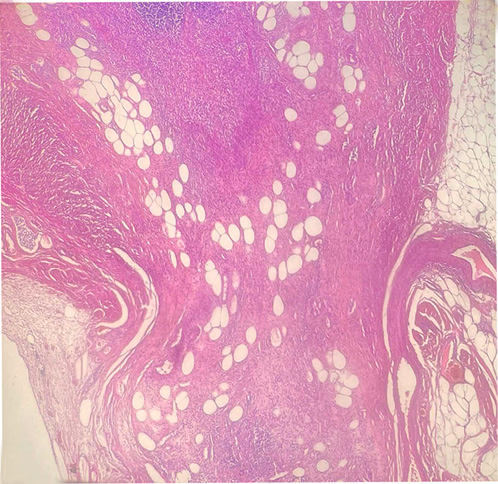
Figure 1. Appendiceal diverticulum. Hematoxylin and eosin–stained section (×40) demonstrates a diverticular outpouching of the appendiceal wall characterized by herniation of mucosa and submucosa through the muscular layer, with surrounding inflammatory changes in the adjacent wall and periappendiceal tissue.
Histopathological examination revealed acute phlegmonous appendicitis with transmural neutrophilic infiltration. An appendiceal diverticulum was identified, characterized by mucosal and submucosal herniation through the muscular layer, without transmural necrosis, perforation, or fibrinopurulent peritonitis (Figure 1). Microbiological culture yielded Escherichia coli, Bacillus subtilis, and Candida albicans. The postoperative course was uncomplicated.
Case B. Gangrenous diverticulitis of the appendix with early systemic inflammatory response
A 26-year-old female presented with acute right lower quadrant abdominal pain of 12 hours’ duration. Laboratory evaluation demonstrated leukocytosis (15×10⁹/L) with marked neutrophil predominance (NLR 23.5). C-reactive protein was 11.6 mg/L, while serum albumin was 40.0 g/L (CRP-to-albumin ratio 0.29). Procalcitonin was elevated at 1.18 ng/mL. Total serum bilirubin was mildly elevated at 18.1 μmol/L (direct ٣.٥ μmol/L). Aspartate aminotransferase and lactate dehydrogenase were within reference ranges. Viral hepatitis serology and peripheral blood smear were unremarkable.
Appendectomy was performed due to clinical suspicion of complicated appendicitis. Histopathological examination demonstrated diverticulosis of the appendix complicated by acute gangrenous diverticulitis, with extensive transmural necrosis, fibrinopurulent peritonitis, and inflammatory involvement of periappendiceal adipose tissue (Figure 2–3). Concurrent acute phlegmonous appendicitis was also present. Microbiological cultures yielded Enterobacter species and Bacillus subtilis.
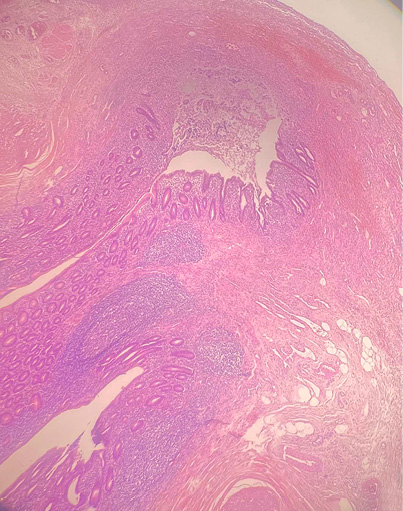
Figure 2. Diverticulitis of the appendix. H&E, ×40. Low-power view demonstrates a diverticular outpouching with marked inflammatory infiltrate involving the appendiceal wall and adjacent tissues, consistent with active diverticulitis.
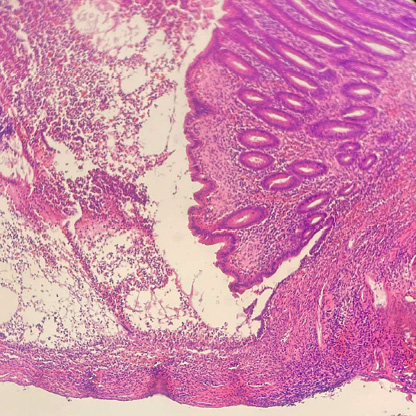
Figure 3. Gangrenous diverticulitis of the appendix. Hematoxylin and eosin–stained section (×100) demonstrates a diverticular outpouching with extensive transmural inflammatory infiltrate, areas of tissue necrosis, and disruption of the appendiceal wall. The serosal surface is covered by fibrinopurulent exudate, consistent with associated peritonitis.
Discussion
This paired case contrast illustrates the heterogeneity of inflammatory trajectories in acute appendicitis and underscores the conceptual limitations of a purely time-dependent continuum model [1, 2]. Although appendiceal diverticular disease has been associated with higher rates of complicated appendicitis, the present cases demonstrate that the presence of a diverticulum alone does not predetermine disease severity [7–9]. Instead, the findings support a more nuanced interpretation consistent with hybrid models of appendicitis pathophysiology, in which disease evolution may follow divergent pathways [5, 6].
Both patients had histologically confirmed appendiceal diverticular disease, yet their clinical courses differed markedly. Case A followed a localized phlegmonous inflammatory trajectory despite a longer symptom duration, whereas Case B progressed rapidly to gangrenous diverticulitis with fibrinopurulent peritonitis within 12 hours. This dissociation between symptom duration and severity challenges the traditional continuum concept and aligns with observations supporting biologically distinct or partially divergent disease processes in acute appendicitis [3–6]. Within the hybrid framework, appendiceal diverticulum may act as a conditional modifier, facilitating alternative inflammatory pathways under specific anatomic, microbial, or host-response conditions rather than serving as a deterministic risk factor.
The behavior of serum bilirubin in these cases provides additional insight into the systemic expression of disease severity. In Case B, bilirubin elevation was mild in absolute terms but directionally distinct, occurring early in association with gangrenous inflammation, marked neutrophil predominance, elevated procalcitonin, and peritoneal involvement. In contrast, bilirubin levels remained within normal limits in Case A despite higher C-reactive protein values and longer symptom duration. This pattern is consistent with evidence suggesting that bilirubin reflects systemic inflammatory response and endotoxemia rather than localized inflammatory burden or disease duration alone [10–12]. Differences in biomarker kinetics likely contribute to this dissociation, as CRP tends to correlate with cumulative inflammatory burden over time, whereas bilirubin elevation may signal early systemic involvement.
Microbiological findings in the present cases are reported primarily for completeness and contextual interpretation. Although Gram-negative organisms were identified in the gangrenous case, culture results do not quantify bacterial virulence or burden and may be influenced by sampling conditions and perioperative factors. Accordingly, microbiological data are not interpreted mechanistically but are consistent with the observed pattern of systemic inflammatory response in the more severe case.
Taken together, these observations refine the hybrid model of acute appendicitis by illustrating how similar anatomic substrates may be associated with divergent inflammatory trajectories. Rather than functioning as a deterministic cause of severe disease, appendiceal diverticulum may modify the course of appendicitis by interacting with microbial factors and host response patterns. Within this framework, serum bilirubin appears to serve as a marker of systemic inflammatory expression rather than local pathology or inflammatory burden alone. Although limited by its case-based design, this analysis provides a clinicopathological illustration that supports contemporary conceptual models of appendicitis heterogeneity and highlights the value of integrative biomarker interpretation.
Conclusion
This hypothesis-generating paired case contrast demonstrates that appendiceal diverticular disease may modify the inflammatory trajectory of acute appendicitis without acting as a deterministic driver of disease severity. Divergent clinical courses in the presence of similar anatomic substrates support the hybrid model, in which severity may arise through distinct inflammatory pathways rather than solely through time-dependent progression. Within this framework, serum bilirubin appears to reflect systemic inflammatory response patterns rather than local pathology or inflammatory burden alone. These findings underscore the value of integrative clinicopathological analysis in refining conceptual models of acute appendicitis.
Author contributions
Radomir Gelevski – concept and design, literature collection and data search, drafting the manuscript, critical revision, data analysis and interpretation, final approval of the version to be published.
Gjorgji Jota – drafting the manuscript, critical revision, final approval of the version to be published.
Blagica Krsteska – drafting the manuscript, data analysis and interpretation, final approval of the version to be published.
Vladimir Andreevski – drafting the manuscript, critical revision, final approval of the version to be published.
References
1. Reisman M. A concise pathophysiological model of acute appendicitis against the background of the COVID-19 pandemic. Front Pediatr 2022; 10: 908524.
2. Dahiya DS, Akram H, Goyal A, Khan AM, Shahnoor S, Hassan KM, Gangwani MK, Ali H, Pinnam BSM, Alsakarneh S, Canakis A, Sheikh AB, Chandan S, Sohail AH. Controverses and future directions in management of acute appendicitis: An updated comprehensive review. J Clin Med 2024; 13(11): 3034.
3. Skjold-Ødegaard B, Søreide K. The diagnostic differentiation challenge in acute appendicitis: How to distinguish between uncomplicated and complicated appendicitis in adults. Diagnostics 2022; 12(7): 1724.
4. Bom WJ, Scheijmans JCG, Salminen P, Boermeester MA. Diagnosis of uncomplicated and complicated appendicitis in adults. Scand J Surg 2021; 110(2): 170–179.
5. Lee HG, Park IJ. Clinical outcomes and optimal indications for nonoperative management of acute appendicitis in adult patients: A comprehensive literature review. Ann Coloproctol 2025; 41(2): 107–118.
6. Blohs M, Mahnert A, Brunnader K, Flucher C, Castellani C, Till H, Singer G, Moissl-Eichinger C. Acute appendicitis manifests as two microbiome state types with oral pathogens influencing severity. Gut Microbes 2023; 15(1): 2145845.
7. Vidović S, Čekić N, Šuvak I, Ugljarević M, Pogorelić Z. Acute appendicitis or appendiceal diverticulitis: A case report and systematic literature review. Clin Pract 2025; 15: 60.
8. Gandhi S, Blomquist GA, Weaver AJ, Denning KL, Diks J. Appendiceal diverticulitis masquerading as perforated acute appendicitis: Diagnostic pitfalls with a potential computed tomography radiologic clue. Cureus 2025; 17(9): e91798.
9. Karamitas Y, Chiang J, Vu AH, Kumar S. Diverticular disease of the appendix: A rarely identified pathology prior to surgery. Cureus 2025; 17(9): e93547.
10. Alfehaid MS, Babiker AM, Alkharraz AH, Alsaeed HY, Alzunaydi AA, Aldubaiyan AA, Sinyan HA, Alkhalaf BK, Alshuwaykan R, Khalil R, Al-Wutard O. Elevated total and direct bilirubin are associated with acute complicated appendicitis: A single-center based study in Saudi Arabia. BMC Surgery 2023; 23: 342.
11. Basukala S, Gurung S, Tamang A, Shrestha O, Devkota M, Thapa N, Pathak B, Mehta K, Bhattarai AM. Diagnostic value of biochemical markers in prediction of perforation in acute appendicitis: A cross-sectional study. Ann Med Surg 2024; 86(1): 6495–6501.
12. Sardoo HM, Rashidi FSM, Kohan BF, Dehdashti N, Shokoufamanesh A, Raesi R, Hushmandi K, Daneshi S. A case-control study of the correlation between serum bilirubin levels and various types of appendicitis. Open Public Health J 2024; 17: e18749445326476.